


© 2006 - 2025 brand-newhomes.co.uk - All rights reserved



Timber Frame what you should know
There are several additional factors to consider before buying a UK new home built in timber frame. This type of construction may give the home owner certain issues and problems which they would not have with a new home built using mainly masonry materials.
Timber frame implies a sturdy large sectional timber framework. However, most modern "timber frame" new homes are constructed using factory-made timber panels that are then nailed together on the site.
"brick-built or timber frame
- I know which I prefer"
Durability
Modern day timber frame components are preservative treated. However this is only fully effective if the timber is not drilled or cut. All cut ends should be re treated with preservative! It is somewhat inevitable that some components will require "site alteration" to suit as-built site sizes and site tolerances. It is also a moot point whether the timber treatment offers full long term protection against all known possible detrimental effects to timber. Timber fence posts are treated but can and do still rot!
The modern timber frame home is not the same as the older type of timber framed buildings built by our Tudor ancestors consisting of large section 8” x 8” solid hardwood Oak frames that have stood the test of time. Modern mass produced timber frame homes have been built since the 1970’s and the very oldest are still less than 40 years old. The timber frame itself is normally "guaranteed" by the manufacturer for various periods ranging from 10 to 40 years. It is a commonly perceived opinion within the industry that 25 –30 years is a reasonably expected life span for a softwood timber framed building. This is the same period as the average length of mortgage. No one would buy a leasehold property with 30 years left on the lease!
Quality issues with timber frame new homes
Fire and timber frame new homes
Timber rot and pests
Timber is vulnerable to both wet and dry rot and from attack by a variety of insects and vermin. For more information on what can destroy a timber frame home CLICK PDF download
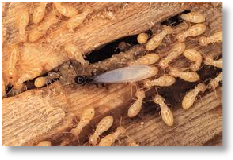
Termites that originate from mainland Europe have recently been found in some counties in the UK. They are white ant-like insects that destroy timber. Termites eat 24 hours a day 7 days a week and have caused billions of dollars worth of damage to property and homes in America. Termites and other insects don’t eat concrete or brick, so termite protection and repair costs are not necessary or a concern in a traditionally-built masonry new home.
To lessen the possibility of wet rot it is generally accepted that the timber frame should not be covered until the moisture content is at 20% or below. This is when the thermal insulation, vapour barrier and plaster boarding can be commenced. However, how many site managers know this, check this or even have a moisture meter? The most critical element is the sole plate, a structural timber fixed to the ground floor onto which the wall panels are fixed. This is often immersed in standing water for a period while the frame and roof are constructed, especially so in multi-storey buildings.
Insurers increasingly include a general provision that excludes dry and wet rot. Hardly any policies cover damage caused by vermin, but damage by fire and flood is normally included in the cover provided. Termite damage is not covered by UK insurance policies. Loss or damage caused by damp is generally excluded and poor maintenance of your house can actually invalidate your policy. See also Safe and Secure download PDF
Insurers are now looking at the increased fire risk posed by timber frame construction in new homes, especially in apartment blocks and terraces. The building regulations (2011) require at minimum one-hour fire protection for the timber frame. But timber burns - concrete block walls do not.
Condensation
Condensation is the most common form of dampness in new homes. Condensation leads to mould growth and in many cases the mould and its spores can lead to health complaints and respiratory problems. Condensation is a particular problem in timber frame homes as the polythene vapour barrier installed behind the plasterboard, effectively seals in all the moisture generated by the occupants, through cooking and bathing. It is essential that the extractor fans are used whenever moisture is being generated in the home. It is also advisable despite draughts, to leave all window trickle vents open even in the winter.
If condensation does become a problem both the house builder and NHBC will, in the first instance, suggest that it is a "lifestyle problem" rather than a building defect. The advice given by them is normally to turn up the heating (so the air can accommodate more moisture vapour) and increase ventilation by opening windows to let the moisture laden air (and the heat!) out.
Adaptability and Flexibility
If you choose a masonry home it can be easily extended if you have the extra land. Not so simple for those who live in a timber frame "kit" home, where extensions can be expensive, invasive and have a lengthy design and delivery lead time. DIY jobs such as putting up shelves are much easier in a masonry home; no need to locate support brackets at the stud centres if indeed you can find them!
Timber also requires structural steelwork to support loads that can be accommodated by masonry construction. This can cause an additional problem when the timber frame shrinks as it dries out and the supporting steelwork does not. However, smaller section steel beams can be used to support a light weight timber frame to enable larger rooms free of intermediate support columns.
Security
The type of materials used to construct a new home can influence how resistant the building is to a break-in attempt, especially with terraced houses, apartments and communal living spaces. Party walls are of particular concern as they are normally just a few layers of 12mm fire resistant board fixed to 89 x 38mm timber studwork filled with fibreglass. It is obvious that an intruder will be able to cut his way through a party wall quietly, and fairly quickly using little more than a utility knife or small padsaw. It could be possible to gain access to a whole terrace of homes or a floor of apartments unnoticed by the outside world.
Apartments are particularly vulnerable if built in timber frame. Access can be gained via the stud walls in the communal staircase area or as is quite common, through the roof space via the loft hatch accesses in the staircase area and top floor flats. The party wall fire breaks are formed in either curtains of wire-reinforced fire resistant mineral wool or timber frame panels clad with 12mm fire resistant board - neither much of a match for the burglar who will be able to break in again, unnoticed by anyone.
Finally, any timber frame home that is clad in timber is also more vulnerable to a break in. It is very easy to strip off the cladding and cut through the OSB and plasterboard inner leaf to gain access.
However, with a masonry built new home, knocking an access hole through two 100mm thick leaves of brick or concrete block is not only noisy and would therefore not go unnoticed, but also very hard work!
Energy efficiency
New homes built using timber frame are generally more energy efficient. Thick thermal insulation is placed between the inner leaf studs resulting in only the air in the home being heated, not also the building structure’s inner leaf block wall as is the case with cavity-insulated masonry construction. However it also follows that timber frame homes do tend to suffer more with overheating in the summer.
Noise
The basic rule is that Mass helps to reduce overall noise transmission. Mass is found by multiplying weight by density. A wall constructed using concrete blocks will have around 50% greater sound insulation due to the much higher Mass than an insulated timber stud wall, resulting in less noise being transmitted between adjoining homes that are built using masonry construction. Noise transmission is a particular problem in blocks of flats and terraced houses. Solid concrete floors are much better at reducing the amount of noise transmission between dwellings than timber floors, even with the latest floating floor and noise isolating detailing. Indeed a "floating" timber floor construction may even introduce further problems for the occupant with "springy" floors caused by the sound isolating design.
The timber frame method of construction has also been used to build many of the new "budget" hotels. If you have ever stayed in one, you will be familiar with the noise transfer from adjoining rooms, with TV’s and talking being easily audible and noise from the occupants walking around in the room above. At least with a hotel your disturbance is only temporary.
The English House Condition Survey statistics show that up to 4.7 million people suffer as a result of noise from traffic, industry or noisy neighbours. Noise is one of the most common complaints from homeowners. Whether it is from a noisy neighbour, loud music, dog barking or even the toilet flushing, noise disturbance is a real problem. Local Authorities say that every year they get more complaints about noise than any other issue; it is one that can cause emotional distress and can result in breakdowns in families and communities.
Resale
The majority (75%) of new homes in the UK are built using masonry materials, which continues to be the preferred construction method today as it has been for many years. Indeed new homes of masonry construction are often referred to as "traditionally-built".
Independent research conducted by MORI, found 90% of those questioned preferred the attributes of brick and block built homes. When the time comes to sell your home, a traditionally built home could be more attractive to potential buyers than a timber frame home.
Timber frame construction can offer a viable alternative solution for the self-builder building a single one-off detached home. They will be in a position to inspect every stage of the process and will stand to benefit fully from any cost savings and faster construction time. Do the UK house building companies pass these savings on to their buyers with comparable lower prices for timber frame new home?
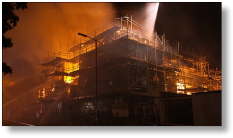
Picture Hampshire fire and resue
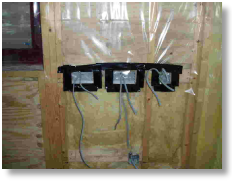
Vapour barrier correctly sealed around sockets
| Micro Homes |
| Studio Apartments |
| Apartments |
| Townhouses |
| Mews Houses |
| Terraced Houses |
| Detached Houses |
| Buying an apartment |
| Leasehold Property |
| Considerations when buying a flat |
| Retirement developments |
| Part exchanging |
| New homes can be bad for your health |
| Why buyers avoid new homes |
| Condensing boilers |
| Brownfield land |
| Consumer Code Dispute Resolution |
| Claiming Compensation - Adjudication Scheme |
| Tricks of the showhome |
| Sales advisors and sales centres |
| Timber frame new homes |
| Timber frame - what you need to know |
| Quality issues with timber frame homes |
| Fire and timber frame new homes |
| What the NHBC does |
| New stamp duty calculator |
| Scotland LBTT calculator |
| Removals and moving home |
| Packing and planning the move |
| Checklist for change of address |
| Choosing a mortgage |
| Avoiding mortgage refusal |
| Rules for new home mortgages |
| Help to Buy |
| First Buy |
| New Buy |
| Best Buys |
| Home Insurance |
| How to save on home insurance |
| Home insurance policy conditions |
| Flood insurance claim |
| Renting do's and don'ts |
| Section 106 Agreements |
| Community Infrastructure Levy 2010 |
| Snagging and Quality |
| Why do new homes have defects |
| Professional snagging |
| Snagging research |
| DIY snagging your new home |
| SNAGGING DEFECT PHOTOGRAPHS |
| External DIY snaglist |
| Internal DIY snaglist |
| External snagging defect photo slideshow |
| Internal snagging defect photo slideshow |
| External snagging defects from new homes |
| Who are the best house builders |
| The worst house builders |
| Builder's end of year figures |
| Finding a new home |
| HBF customer satisfaction survey results |
| NHBC awards league table |
| Job Vacancies |
| Persimmon Homes |
| Taylor Wimpey Homes |
| Barratt Homes |
| Bellway Homes |
| Redrow Homes |
| Bovis Homes |
| Berkeley Homes |
| Linden Homes |
| Crest Homes |
| Miller Homes |
| Bloor Homes |
| Taylor Wimpey on BBC Watchdog |
| New home customer satisfaction surveys |
| HBF New home survey results |
| HBF House builder star rating |
| Site Manager |
| Regional Managing Director 1 |
| Regional Managing Director 2 |
| Executive Chairman 1 |
| Executive Chairman final letter |
| NHBC warranty claim |
| Subject Access Request |
| New Home Blog |
| New Home News |
| Latest news |
| News 2011 |
| News 2010 |
| News 2008 |
| News 2007 |
| News 2006 |