


© 2006 - 2025 brand-newhomes.co.uk - All rights reserved




Disadvantages of brand new homes
There are many more disadvantages than advantages when you buy a new home. You should carefully consider all the drawbacks below before making a decision to buy a new home. Just because you can buy a new home, it doesn’t mean you should!
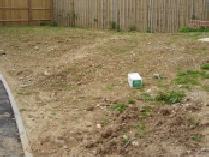
At the very least your rear garden should look like this - minus the box!
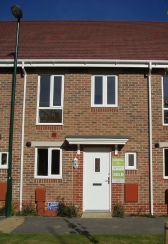
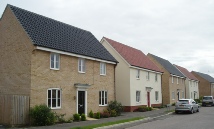
Nearly all homes are badly built
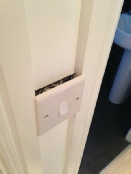 People who buy a new home actually do so expecting it to have defects! They wouldn’t buy a new car that way. It is a sad fact that 93%* of all new homes buyers find preventable defects when they first move in. Even worse, is that after reporting their problems, most of the large builders treat the complaints with complete indifference and their customers with contempt. Our own forum has many stories which demonstrate just how little house builders actually care about the quality of the homes they build and the service they give to their buyers after they have moved in. This is by far the biggest disadvantage of buying a brand new home. You will almost certainly be buying trouble!
*Source HBF Customer Satisfaction Survey average 2006-2015 surveys
Price
New homes are priced at the maximum the market will allow. New homes sell for a premium typically £5,000 to £8,000 more than the equivalent older house because of the advantages stated on this website and to an extent, the costs associated with planning agreements.
It is more difficult to get a mortgage for a new-build home
Lenders have have certain rules and restrictions for mortgages on new homes. Getting a mortgage for a new-build home may be more difficult, more expensive and more time consuming than a loan to buy an older home. The choice of lender is limited especially when buying using schemes such as Help to Buy
New homes are more difficult to sell on
Should you wish to sell before the development is sold out, your 'second-hand' home will be in direct competition with the remaining brand new homes available and the incentives the builder is offering at the time, including Help to Buy. You should also be aware that around 75% of UK home buyers would not buy a home built after 2001.
Living on a building site
Unless you purchase the last home on the development this is inevitable and unavoidable. You will find yourself subjected to mud on the roads, dust, noise, contractor's parking, weekend working and access problems along with filthy windows and a general lack of privacy. You will probably have the 'advantage' that you can dump your rubbish in the builders' skips for a while though!
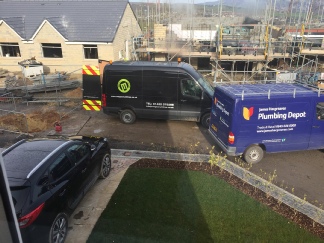
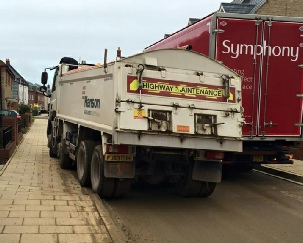
Extras/Options/Finishing Touches
These are offered by most of the major builders as they find them very profitable! Before agreeing to pay for an extra power point or wall and floor tiling, it may be worth talking to the sub contractor direct, as going through the builder can add around 35% to the cost! If the friendly sales advisor is forbidden to tell you who the sub contractor is, ask on site yourself, but avoid the building areas for obvious safety reasons.
Extra charges for private roads and communal open spaces
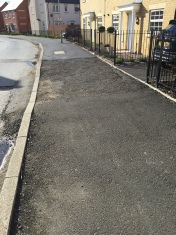 Unlike most existing residential properties, it is becoming increasingly common on new housing developments for roads and other public areas remaining private and not to be taken over and adopted by Local Authorities. The implication for new homebuyers is they are then legally responsible for the maintenance, repair and insurance of the roads and any communal open spaces. Buyers will be required to pay ongoing, potentially ever-increasing, annual management charges, commonly around £200 to £400 a year for each home owner. Apart from the extra and avoidable cost, there are many disadvantages associated with living on a non-adopted new residential estate.
The uncompleted roads and paths (Persimmon development) in the photo (left) taken 30 months after buyer moved in!
Restricted Choices
Most of the larger Plc. house builders have National Agreements with their suppliers. These normally involve suppliers giving large payments or very substantial discounts to the builder. These are in return for an assurance that only the supplier’s materials or products will be used in all the homes built by that builder during the period covered by the agreement. When these agreements are set up, the builder’s directors often select specific product ranges that then further limit the choice available to you. This is particularly noticeable with kitchen unit styles. The regional offices of the larger builders are then tied to the national agreements and resultant specifications set by the builder’s group head office.
Smaller rooms
It should be fully understood that new homes are generally smaller than their older counterparts. In fact some of the older terraced houses in our town centres were large enough for builders to convert into several modern flats! With the ever rising cost of land it is inevitable that developers would seek to maximise their return, by increasing the number of homes on a development whilst maintaining an acceptable building density to placate local planners. This often results in homes being built on a reduced ‘footprint’ with subsequent reductions in room sizes, often to the bare minimum that will be accepted by prospective purchasers. In fact living in a new home can actually damage your health and lead to depression, immune system suppression and diabetes type 2; as well as affecting internal organs such as the digestion system, kidneys and the liver!
Lack of storage space
This is one of the main criticisms people have regarding new homes and why 75% of the population would not even look at any home built after 2001.
If you are lucky (or shrewd) you will have a turfed rear garden included in the price. However unless you specify the type of turf, you will normally be provided with the cheapest available (meadow) or low-grade cultivated, which will suffer before you move in as builders only ever water it in hot weather, if at all. Furthermore, this is always laid to suit the existing and surrounding ground levels, whatever they may be. Builders avoid retaining walls to level gardens because of the cost. This means should you wish to extend your patio or level out an area, this turf will be wasted. Normally your rear garden is left with a layer of spread topsoil - This should be a minimum of 150 mm deep.

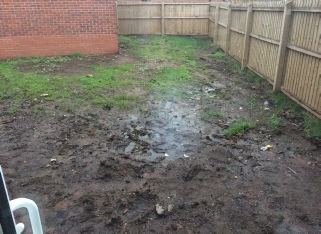
It is not unreasonable to expect this to be loosened and free from weeds and rubble when you move in. This is not always the case as can be seen above! You also need to allow the expense of planting your rear garden and laying lawn to the remainder, costing at least £1,800 for a typically sized new home rear garden. With ever increasing land costs, rear gardens to new homes are generally much smaller than those of older houses. If you are not a keen gardener this may be a blessing, but when you come to sell it may present a problem. There will also be less sun due to the size and neighbouring properties and fencing.
Front Garden
Front gardens are a thing of the past with new homes built after 2000. Some are often just deep enough to accommodate a gas meter box!
Bathroom & Cloakroom Windows
Modern new homes, especially semi-detached, terraced and flats, tend to have bathrooms and cloakrooms that do not have the benefit of a window for both natural light and ventilation.
Rarely some kitchens are also missing a window. A window in these rooms is not a requirement, and it is sacrificed to benefit the remaining accommodation. The house is either too narrow or too small to facilitate a better design layout that would enable the bathroom to have an external wall and therefore a window. Even the windows a new home does have are usually the smallest that regulations allow.
Social and Affordable Housing
Another factor you can now not avoid is the provision of social and/or affordable housing on a development. This is stipulated as part of the planning process under a Section 106 Agreement – part of the Town and Country Planning Act 1990. Such provision is encouraged by central government. Generally, any development of 15 homes or more attracts a requirement for social and/or affordable housing. This can be as much as 30% of the development. In the past any social housing would be at one end of the development and relatively self-contained. However it is now more common to see the social housing provision integrated with the homes for sale throughout the development. This may be a particular problem in blocks of flats. The cost of this requirement can increase the price paid for the homes sold on the open market on the development.
High density developments - lack of privacy
The Government produced a document called PPS3, a planning policy statement that replaced the previous PPG3 guideline on density of developments. It basically relaxed requirements for parking space provision, open space, estate roads etc. and gave developers an opportunity to cram as many plots on to a development as their designers could squeeze on. This results in cramped developments with little or no on street parking and front doors opening directly on to the public footpath. Even if the development escapes PPG3 requirements, it is still likely to be of a far higher density than those built ten years ago. Most rear gardens are overlooked by more than two of their neighbours. Front gardens are all but non-existent. (see above)
Lack of Parking
Requirements for the minimum number of parking spaces per home (previously 2 spaces per home and 3 for a four-bedroom home) have been relaxed. The thinking behind this being an effort to limit the number and use of cars and also to enable more of the development site to be built on, making better use of the land available and thus reducing the green field land requirement for new housing. This can sometimes result in your one parking space being located in your rear garden!
Mobility - changes to Building Regulations
All new homes are subject to mobility standards. In short this stipulates a minimum size for access doors to ground floor rooms as well as the principal entrance door. Other requirements include minimum widths for access in hallways and the provision of a ground floor cloakroom, to a certain minimum size. This can often result in the remaining rooms on the ground floor being reduced in size to enable the minimum requirements for wider hallways and the cloakroom to be achieved. In addition, the increased width and revised positioning of ground floor doors may limit room furnishing options due to the wider doors.

| Micro Homes |
| Studio Apartments |
| Apartments |
| Townhouses |
| Mews Houses |
| Terraced Houses |
| Detached Houses |
| Buying an apartment |
| Leasehold Property |
| Considerations when buying a flat |
| Retirement developments |
| Part exchanging |
| New homes can be bad for your health |
| Why buyers avoid new homes |
| Condensing boilers |
| Brownfield land |
| Consumer Code Dispute Resolution |
| Claiming Compensation - Adjudication Scheme |
| Tricks of the showhome |
| Sales advisors and sales centres |
| Timber frame new homes |
| Timber frame - what you need to know |
| Quality issues with timber frame homes |
| Fire and timber frame new homes |
| What the NHBC does |
| New stamp duty calculator |
| Scotland LBTT calculator |
| Removals and moving home |
| Packing and planning the move |
| Checklist for change of address |
| Choosing a mortgage |
| Avoiding mortgage refusal |
| Rules for new home mortgages |
| Help to Buy |
| First Buy |
| New Buy |
| Best Buys |
| Home Insurance |
| How to save on home insurance |
| Home insurance policy conditions |
| Flood insurance claim |
| Renting do's and don'ts |
| Section 106 Agreements |
| Community Infrastructure Levy 2010 |
| Snagging and Quality |
| Why do new homes have defects |
| Professional snagging |
| Snagging research |
| DIY snagging your new home |
| SNAGGING DEFECT PHOTOGRAPHS |
| External DIY snaglist |
| Internal DIY snaglist |
| External snagging defect photo slideshow |
| Internal snagging defect photo slideshow |
| External snagging defects from new homes |
| Who are the best house builders |
| The worst house builders |
| Builder's end of year figures |
| Finding a new home |
| HBF customer satisfaction survey results |
| NHBC awards league table |
| Job Vacancies |
| Persimmon Homes |
| Taylor Wimpey Homes |
| Barratt Homes |
| Bellway Homes |
| Redrow Homes |
| Bovis Homes |
| Berkeley Homes |
| Linden Homes |
| Crest Homes |
| Miller Homes |
| Bloor Homes |
| Taylor Wimpey on BBC Watchdog |
| New home customer satisfaction surveys |
| HBF New home survey results |
| HBF House builder star rating |
| Site Manager |
| Regional Managing Director 1 |
| Regional Managing Director 2 |
| Executive Chairman 1 |
| Executive Chairman final letter |
| NHBC warranty claim |
| Subject Access Request |
| New Home Blog |
| New Home News |
| Latest news |
| News 2011 |
| News 2010 |
| News 2008 |
| News 2007 |
| News 2006 |