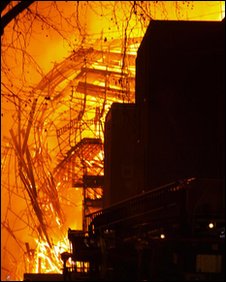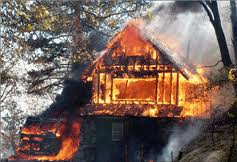
Would you rather be in a masonry new home or timber frame new home when the home next door is on fire?
It is becoming more common for sprinkler systems to be specified and installed in new timber frame buildings, most notably nursing homes, as owners are all too aware of the consequences of a fire in a timber framed building.
The construction and type of materials used in a new home will also influence how easily and efficiently the house can be restored or refurbished after an incident such as fire or flood. For more information visit: www.timberframefires.co.uk
Fire and timber frame new homes
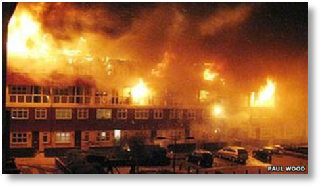
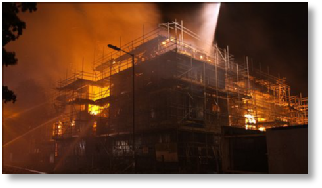
Picture: Hampshire fire and resue
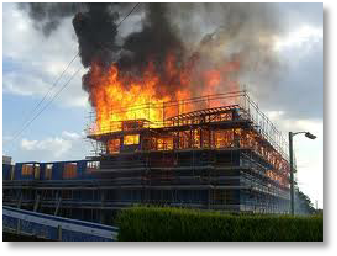
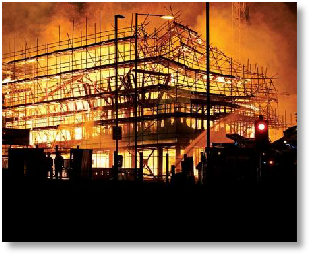
The President of the Chief Fire Officers Association John Bonney does not agree. After the recent timber frame fire on a building site in Basingstoke there are concerns that firemen are at a greater risk due to the instability of the burning timber structure collapsing around them. He said, “When timber-framed buildings catch fire the actual structure burns. It often leads to total collapse and that puts the safety of our fire-fighters at risk.”
After the fire was extinguished at the building site in Basingstoke, all that remained was the tube scaffolding, the block-built lift shaft and some structural steel columns and beams which had supported the now totally destroyed timber floor.
It can therefore be demonstrated that, unlike other materials, timber burns away to such an extent that nothing is left. Concrete, brick and block do not burn at all. It should also be noted that structural steelwork is used more often in timber frame building design due to the structural load bearing limitations of the timber components in relation to the modern requirement of open plan design layouts. Anyone considering buying a timber frame home, in particular a terraced house or apartment should answer this question:
Fire occurrence
On average around 200 homes catch fire every day in the UK resulting in one death and 40 people being injured. The UK Building Regulations state minimum fire resistance requirements for all new homes and buildings regardless of the materials used in construction. This minimum requirement being that the structure has to survive intact and prevent fire spread for approximately 30 minutes to enable the safe exit of people. Far exceeding this minimum, a masonry house built with concrete pre-cast floors offers over 4 hours of protection to its occupants.
Unlike timber, masonry cannot burn. Even in the worst fire a masonry house or apartment block will maintain its structural integrity, with only the timber elements requiring replacing. Homes built using traditional construction protect against the spread of fire between rooms or properties, as masonry cannot catch fire, burn or drip molten particles. A timber frame home is in most cases totally destroyed.
Download PDF report Click
In answer to the question "Is a Timber frame house at more risk from fire?" the supporters of timber frame construction the UK Timber Frame Association, and manufactures reply: "Unlike other forms of construction, Timber Frame does not bend or flake when subject to high temperatures this allows for a slow and controlled loss of structural integrity which can make less likely to collapse and therefore safer than homes built using other methods."